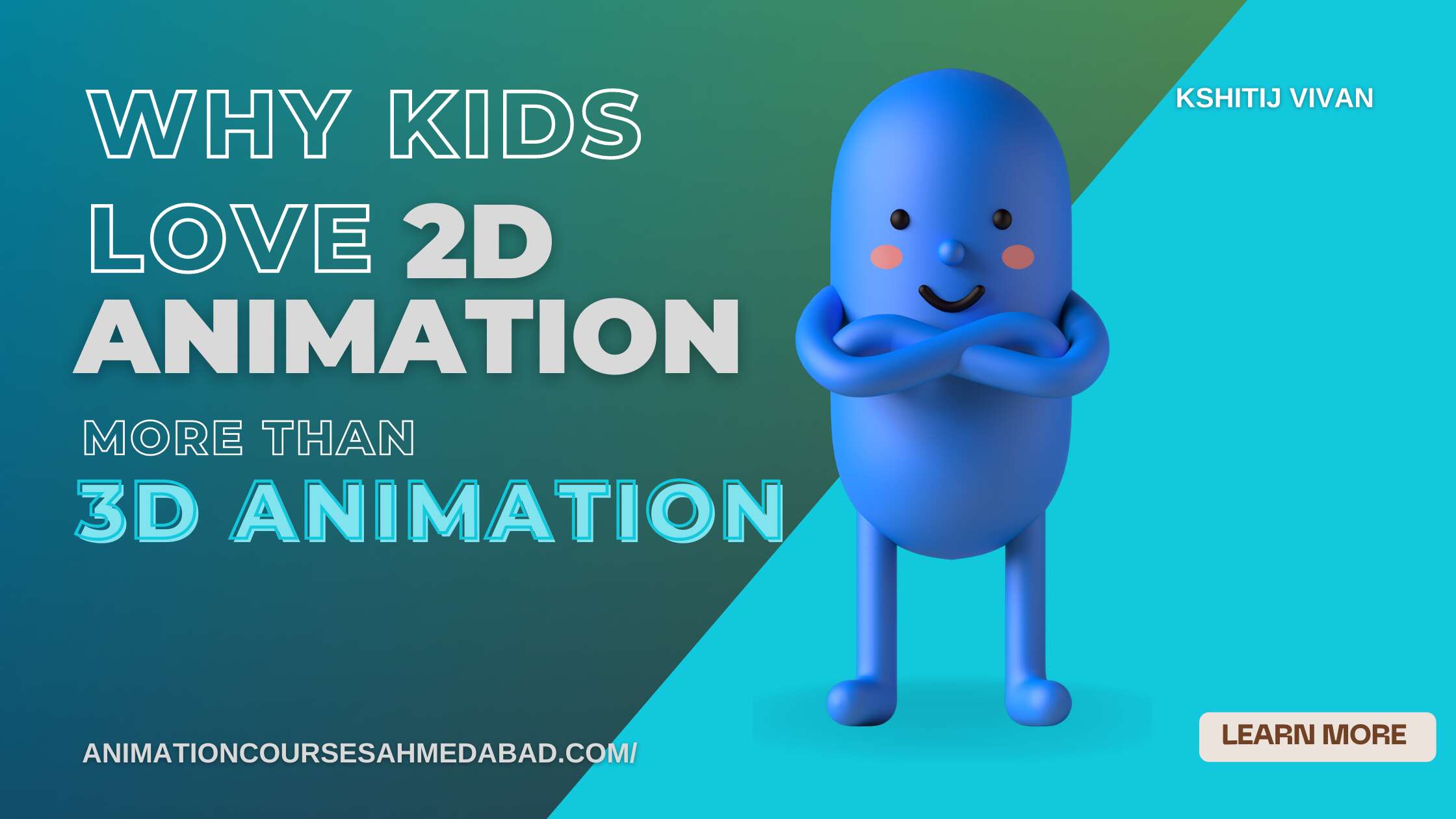
Why Kids Love 2D Animation More Than 3D
Even with the rise of high-quality CGI movies and realistic 3D animation, children across the world continue to prefer the charm, simplicity, and energy of classic 2D animation. Characters like Tom & Jerry, Doraemon, Mickey Mouse, and Shinchan still capture the attention of kids far more easily than many modern 3D animated shows.
But why?
The answer lies in how children see the world, how they process visuals, how they understand emotions, and how certain storytelling techniques connect better with young minds. Understanding these factors helps animators, parents, teachers, and content creators make better choices when designing content for kids.
Let’s explore the deeper reasons behind this preference.
How Kids See Visuals
Simpler visuals are easier for kids
Young children process information differently from adults. Their brains are still developing the ability to understand depth, perspective, shadows, and fine details.
2D animation removes all unnecessary visual noise, presenting characters and scenes in a straightforward, easy-to-understand way.
Flat shapes, limited movement complexity, and clear visual cues help the child’s brain recognize what’s happening instantly.
This simplicity makes 2D animation naturally appealing and comfortable for young eyes.
Kids understand 2D faces faster
In 2D cartoons, faces are:
- Bigger
- Clearer
- More exaggerated
- Easy to read
Kids can quickly understand whether a character is happy, sad, surprised, scared, or angry because 2D expressions are pushed to the extreme. The lack of realistic shading and facial complexity means children identify emotions instantly.
In contrast, 3D faces involve subtle expressions, texture details, and more natural movement—great for adults, but challenging for small children.
Clearer emotions in 2D
Emotional clarity is one of the strongest advantages of 2D animation.
Characters stretch, squash, bend, bounce, and react wildly, making every emotion easy to interpret.
Kids understand:
- happiness because the mouth opens wide
- shock because eyes pop out
- anger because the face turns red
- sadness because tears appear instantly
This direct emotional storytelling connects deeply with kids.
Why 3D realism can confuse children
3D animation includes:
- realistic lighting
- shadows
- reflections
- detailed textures
- complex backgrounds
All these create a level of visual realism that younger kids are not mentally prepared to process.
When characters look semi-real, but still cartoonish, it can be even more confusing—known in psychology as the uncanny valley effect.
This is why overly realistic 3D often appeals more to older kids or adults, not toddlers or preschoolers.
Emotional Connection
Exaggerated expressions in 2D
2D animation excels in exaggeration.
Characters can stretch far beyond human limits, bouncing and morphing in ways impossible in real life.
For children, this exaggeration creates instant joy, laughter, and emotional bonding.
They love the silliness, the big reactions, and the expressive faces that 2D is famous for.
Slapstick humor works better in 2D
Classic slapstick humor—falling, chasing, hitting, jumping, exploding, flying—looks entertaining and funny in 2D.
Since the world is drawn, kids never associate the action with real-life danger.
Tom & Jerry, Looney Tunes, and Oggy & the Cockroaches are perfect examples.
In 3D, similar slapstick sequences can look too realistic, reducing their comedic effect for children.
2D characters look friendlier
2D characters are softer, rounder, simpler, and more colorful.
They resemble drawings children make themselves, so they feel familiar and approachable.
3D characters, even when cute, often have:
- realistic skin
- detailed hair
- shadows
- reflective surfaces
These details create emotional distance for very young viewers.
Nostalgia from older cartoons
Most parents introduce their children to the cartoons they grew up with.
This creates a generational nostalgia cycle.
Kids begin watching:
- Tom & Jerry
- Mickey Mouse
- Doraemon
- Chhota Bheem
- Classic Disney shorts
Once they get used to this style at an early age, 2D becomes their comfort zone.
Visual & Artistic Differences
Simple shapes and bold colors in 2D
2D animation relies on strong, clean shapes:
- circles
- ovals
- triangles
- squares
These are shapes very young kids can easily draw and recognize.
Bright, flat colors also keep their attention better than textured or shaded 3D surfaces.
Clean outlines help kids focus
2D cartoons use bold lines around characters, creating separation from the background.
Kids' eyes quickly identify who the main character is and where to focus.
3D has no outlines, so figures blend naturally into the environment—beautiful for adults, but less clear for kids.
Handmade feel of 2D
2D animation feels human.
Whether drawn digitally or by hand, it carries an artistic warmth.
Kids naturally connect with drawings because:
- they look like picture books
- they resemble their own doodles
- they feel soft and friendly
3D animation looks polished but can feel less personal.
How 2D animation timing is different
2D timing uses:
- simple motion
- exaggerated actions
- clear pauses
- rhythmic movement
Kids follow the story easily because every action is exaggerated and well-paced.
3D timing sometimes tries to mimic real life, making movement more complex and less predictable for young minds.
Storytelling Differences
2D focuses more on characters
Many 2D cartoons prioritize:
- personalities
- expressions
- comedic timing
- relationship dynamics
Kids connect to characters first, visuals second.
Shorter, simpler stories
Most 2D episodes are 7–12 minutes long.
Perfect for kids’ short attention spans.
3D movies or series often have longer, more complex plots.
Easy-to-understand humor
2D humor is:
- visual
- physical
- direct
- predictable
- instantly funny
Kids don’t need dialogue to laugh at a 2D scene.
In 3D movies, humor can be more situational or story-based, requiring more understanding.
Why 2D stories stick longer
Strong character expressions + simple conflicts + fun humor = long-term memory retention.
Kids remember:
- Tom chasing Jerry
- Nobita crying
- Mickey waving
- Shinchan dancing
These interactions shape childhood memories.
Educational Benefits
2D helps learning better
For educational content, 2D is more effective because:
- symbols are clearer
- visuals are simpler
- information is easier to follow
- less distraction from details
This is why most school animations and learning apps use 2D.
Used more in school content
Classrooms use 2D animated videos for:
- alphabets
- number learning
- science concepts
- moral stories
- language learning
Simple visuals make it easier for students to absorb information.
Safe, comforting visuals
2D is non-threatening and friendly.
Even when showing conflict or action, it never feels too intense or realistic.
This creates a safe viewing environment for kids.
Better memory retention for kids
Because 2D characters are simpler, children remember:
- faces
- colors
- shapes
- repeated actions
- story patterns
This improves cognitive development and recall.
Technical Differences Between 2D and 3D
Understanding the technical foundation of 2d animation and 3d animation helps explain why kids respond differently to each animation style. Both forms are powerful, but their creation process and emotional impact vary.
How 2D animation is created
Traditional 2d animation is based on drawings and flat shapes. Whether it’s hand drawn animation, digital frames, or software-assisted motion, the process involves:
- Character sketches
- Key poses
- In-between drawings
- Flat colors
- Clean outlines
- Simple backgrounds
Many modern artists use 2d animation software like Adobe Animate to speed up the 2d animation process. Even in digital form, the charm remains the same: expressive, simple, friendly visuals.
Because 2D stays inside a flat canvas, it avoids the complexity of depth, shadows, and advanced rendering. This is why educational animation and kids’ explainer videos largely rely on 2D — it’s clear and easy to follow.
How 3D animation is created
In computer animation, the workflow is much more complex. A 3d animator must build a full 3d model, design a 3d environment, add textures, lighting, and animate movement inside 3d space.
The typical 3d animation process includes:
- Modeling 3d objects
- Rigging the skeleton
- Applying materials
- Setting up the scene
- Animating the 3d character
- Rendering frames
- Compositing and final video production
Software like 3ds Max, Maya, and Blender help studios build high-quality 3d animation work, but the process takes time, skill, and higher 3d animation cost.
This complexity is one reason why 3d animation excels at realism but may feel visually overwhelming for younger children.
Pros and cons of each
2D Animation – Pros
- Easy for kids to understand
- Clear shapes and expressive animated characters
- Faster for short animated video content
- Affordable for 2d animation services
- Ideal for cartoons and traditional 2d animation
2D Animation – Cons
- Limited realism
- Depth and shadows require extra work
- Complex action scenes need many drawings
3D Animation – Pros
- Ultra-realistic visuals
- Rich worlds and environments
- Smooth motion animation
- Great for long-form stories
- Ideal for video games and films like Toy Story
3D Animation – Cons
- Expensive 3d animation services
- Requires advanced animation software
- Subtle expressions may confuse small children
Why 3D excels in realism
3D offers:
- Realistic lighting
- Surface textures
- True depth
- High-detail 3d objects
- Natural shadows and reflections
- Advanced cg animation effects
This is why epic films like Toy Story became global hits. Older kids appreciate these detailed worlds, while toddlers often find them visually heavy.
Age-Based Preferences
Why toddlers love 2D
Toddlers rely on:
- Simple shapes
- Bold outlines
- Slow pacing
- Repetitive actions
This makes 2d animation perfect for them. The lack of visual complexity keeps their attention and supports learning.
Shows with simple motion graphic elements also help toddlers understand movement without confusion.
Why older kids start liking 3D
As children grow (ages 7–10), they develop the ability to understand:
- Depth
- Motion realism
- Complex scenes
- Emotional subtleties
At this stage, they are attracted to 3d animation, adventure stories, and cinematic visuals. They can also appreciate deeper visual storytelling where character expressions and movement feel more natural.
Influence of movies like Toy Story
Films like Toy Story, Frozen, and Moana introduce kids to the magic of 3d cgi. These movies blend humor, emotion, and breathtaking worlds, making older kids fall in love with 3D.
Toy Story especially showed how 3d animation can deliver emotional depth while still feeling playful.
The role of video games
Modern video games use advanced 3d animation techniques, lifelike 3d characters, and immersive environments. As kids start gaming, their appreciation for 3d animation grows naturally.
Games also teach kids how to navigate a 3d environment, improving their comfort with depth, motion, and spatial visuals.
How 2D & 3D Work Together
Hybrid animation styles
Today’s studios often combine 2d and 3d animation to create unique looks.
Examples include:
- 2D outlines on 3D characters
- 3D backgrounds with 2D effects
- 3D rigs animated in a 2D way
This blend offers the clarity of 2D with the depth of 3D.
Modern shows mixing both
Popular shows now mix motion graphics, 2D cartoons, and 3D elements in the same scene.
Examples:
- Doraemon (2D characters, 3D props)
- Ben 10 (2D style with 3D creatures)
Kids love this mix because it gives freshness without overloading their senses.
Motion graphics in kids’ content
Many learning apps, OTT platforms, and YouTube channels use motion graphics because:
- They are simple
- Visually clean
- Great for explaining concepts
- Perfect for young learners
Motion graphics bridge the gap between 2D simplicity and 3D motion.
Tips for 3D Animators
If you’re working in 3d animation or offering 3d animation service, here’s how to make your content more kid-friendly.
Add 2D exaggeration to 3D
Use squash-and-stretch, big expressions, and bold poses — like 2D does.
This makes your animated character more lively and appealing.
Make simpler character designs
Reduce:
- texture detail
- sharp edges
- visual complexity
Kids love rounder, cleaner 3d characters that resemble drawings.
Use brighter colors
Bright palettes feel friendly and connect better with young audiences than realistic shading.
Bring storytelling first
Kids follow stories more than visuals.
Strong character personalities matter more than advanced 3d animation work.
Blend 2D FX into 3D animation
Add:
- 2D tears
- 2D sparkles
- 2D smoke
- 2D impact frames
This gives your computer animation the joy and charm of traditional cartoons.
Learn Animation Professionally at Kshitij Vivan
If reading this has inspired you or your child to explore the world of animation, now is the perfect time to start learning professionally.
At KSHITIJ VIVAN – Ahmedabad’s Leading Animation & Multimedia Training Academy, we offer:
🎨 2D Animation Courses
🎥 3D Animation Courses
✨ VFX & Motion Graphics
🖥️ Digital Art & Illustration
🧩 Game Design Basics
📚 Short-Term Software Training (Maya, 3ds Max, Adobe Animate, After Effects)
Why students choose us:
- 📌 Industry-expert trainers
- 📌 100% practical, project-based learning
- 📌 Studio-style training environment
- 📌 Personal guidance for every student
- 📌 Placement assistance in top animation studios
Whether you want to become a 2D animator, 3D animator, motion graphics artist, or a professional in video production, we help you build real skills and a strong portfolio.
👉 Call Now: 9137440042
👉 Visit Us: Shivranjani & CG Road Centers (Ahmedabad)
👉 Join Free Demo Class: Experience our teaching before enrolling!
Start your animation journey with confidence — your dream career begins at KSHITIJ VIVAN.
❓ Frequently Asked Questions (FAQ)
1. Why do kids love 2D animation more than 3D animation?
Kids prefer 2D animation because it uses simple visuals, bold outlines, bright colors, and exaggerated expressions. Their brains understand and process 2D faster than detailed 3D animation, which can feel overwhelming for younger children.
2. Is 3D animation better than 2D?
Both have strengths.
- 2D is simpler, expressive, and great for storytelling.
- 3D is realistic, immersive, and perfect for movies, games, and modern video production.
Kids respond emotionally to 2D, while older audiences appreciate the depth of 3D.
3. At what age do kids start liking 3D animation?
Most children start shifting toward 3D animation between ages 7–10 as their brains develop better depth perception and visual understanding. This is when they enjoy movies like Toy Story or 3D-based video games.
4. Which is easier to learn: 2D or 3D animation?
For beginners, 2D animation is easier because it focuses on drawing, timing, and simple movement.
3D animation involves modeling, rigging, lighting, rendering, and complex software, making it more technical.
5. Can a student learn both 2D and 3D animation together?
Yes! In fact, learning 2D and 3D animation together makes you a more versatile animator. Many studios hire artists who understand both traditional animation principles and computer animation workflows.
6. What software is used for 2D and 3D animation?
2D Animation Software: Adobe Animate, Toon Boom Harmony
3D Animation Software: Maya, Blender, 3ds Max
Both types of animation software are taught at Kshitij Vivan.
7. Are animation careers good for the future?
Absolutely. The animation industry is growing rapidly across films, OTT platforms, digital marketing, YouTube, gaming, and education. Skilled animators are in high demand, and careers in cg animation, motion graphics, and explainer videos have massive growth.
8. Can my child join animation classes after 10th or 12th?
Yes. Students can begin animation training right after 10th or 12th grade. Creativity matters more than academic marks. We also offer beginner-friendly courses to build strong foundational skills.
9. Do I need drawing skills to study animation?
Drawing skills help in 2D animation, but they are not required for 3D animation. Many successful 3D animators started without advanced drawing ability.
10. What is the career scope after learning animation?
Career options include:
- 2D Animator
- 3D Animator
- Motion Graphics Artist
- Video Editor
- Visual Effects Artist
- Game Designer
- Digital Art Illustrator
- Character Designer
- 3D Modeler
- Lighting Artist
Kshitij Vivan provides placement guidance to help students enter the industry.
CONCLUSION
Kids love 2d animation more than 3d animation because their young minds respond better to simplicity, bold colors, clear expressions, and friendly characters. As they grow older, their interest expands toward cinematic 3d animation, deeper stories, and interactive video games.
Both 2d animation and 3d animation have powerful places in the modern animation industry.
And the future belongs to animators who master both.
Latest Blogs