AI Video Editing Course Bayad
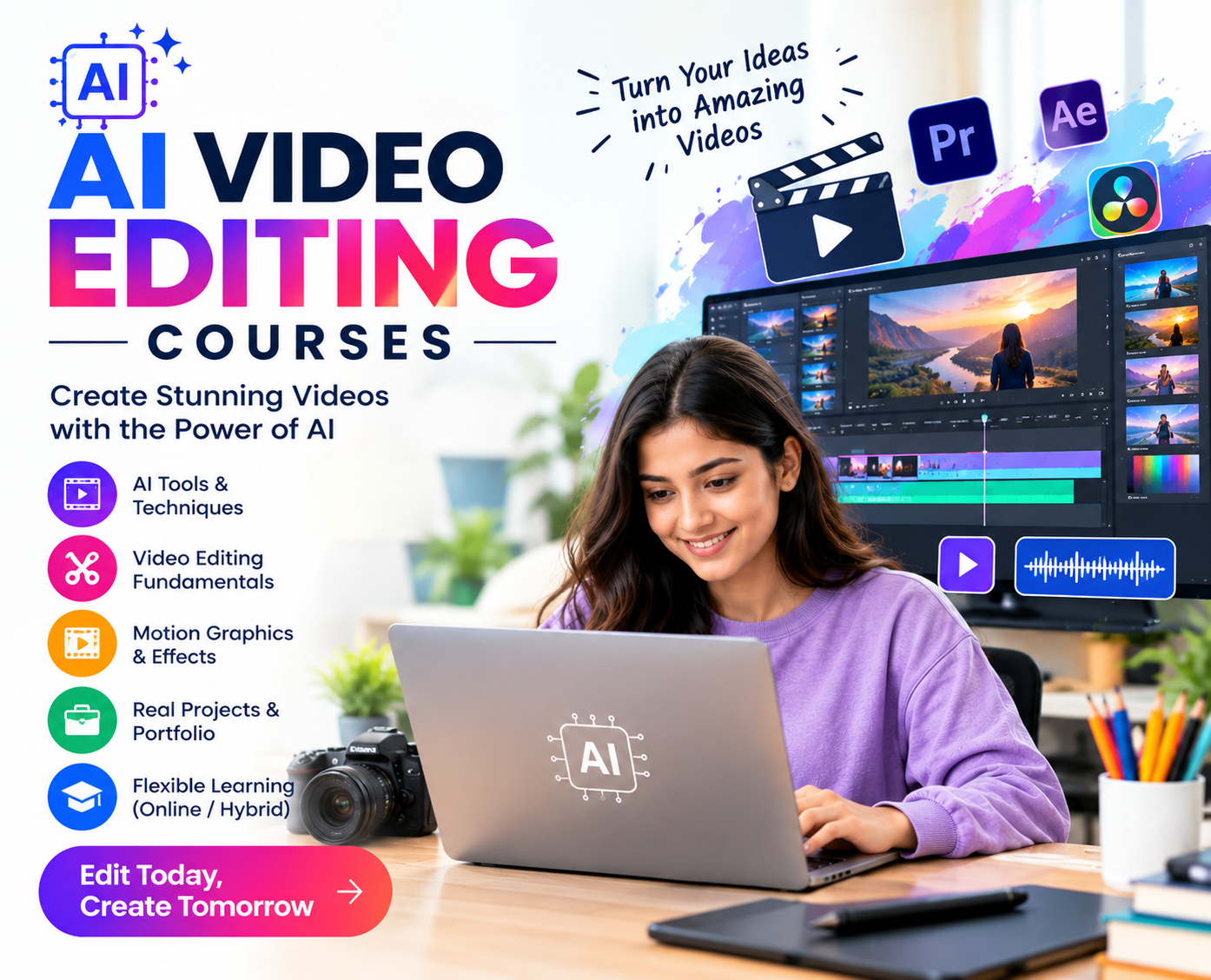
AI Video Editing Course
Duration : 6 Month
Hybrid Fees : Rs 50000/-
Offline : Rs 70000/-
Laptop Complusary
COURSE OVERVIEW
A successful video editor needs to understand storytelling, editing principles, pacing, sound, visual composition, colour, transitions and audience engagement. AI becomes more useful when it is combined with these creative skills. The AI Video Editing Course at Kshitij Vivan is designed for students, beginners, graduates, aspiring video editors, content creators and professionals who want to learn video editing while understanding how AI can be integrated into modern video-production workflows.The course combines video editing fundamentals, professional editing workflows, AI-assisted production, practical projects and portfolio development to help learners build relevant creative skills.
- AI Photoshop
- AI Premier Pro
- AI Audition
- AI Illustrator
- Video Editor
- Social Media Video Editor
- YouTube Video Editor
- Content Editor
- Digital Video Editor
What Is an AI Video Editing Course Bayad?
An AI Video Editing Course teaches the fundamentals of professional video editing along with modern Artificial Intelligence tools and workflows.
Instead of learning AI as a separate technology, students learn how AI can support different stages of video production.
This can include:
- Video editing
- Creative ideation
- Script and content development
- AI-assisted video generation
- Caption generation
- Audio enhancement
- Background removal
- Visual asset creation
- Video resizing and adaptation
- Short-form content creation
- Social media video production
- Workflow automation
The purpose is to develop a video editor who understands both creative storytelling and modern AI-assisted production.
Why Learn Video Editing with AI Bayad?
Traditional video editing requires creative judgement and technical knowledge. AI can make certain parts of the workflow faster, but it does not remove the need for an editor.
For example, AI can assist with repetitive tasks, but an editor still needs to decide:
- Which shot should be used?
- Where should the video cut?
- How fast should the sequence move?
- What music fits the mood?
- What should the audience feel?
- Which visual elements communicate the message?
- How should the final video be structured?
This combination of human creativity + editing expertise + AI tools is becoming increasingly relevant for modern content production.
AI Video Editing Course Syllabus Bayad
A strong AI Video Editing Course should begin with fundamental editing skills before progressing towards AI-assisted workflows.
Module 1: Video Editing Fundamentals
Students begin by understanding the basic principles behind professional video editing.
Topics can include:
- Introduction to video editing
- Understanding footage
- Video formats and resolutions
- Frame rates
- Aspect ratios
- Timeline-based editing
- Cutting and trimming
- Sequence organisation
- Shot selection
- Continuity
- Editing workflow
These fundamentals help students understand why an edit works, rather than simply learning which buttons to press.
Module 2: Professional Video Editing
Students learn how to assemble footage into engaging videos.
Topics can include:
- Timeline editing
- Cutting and sequencing
- Transitions
- Titles
- Graphics
- Audio synchronisation
- Multi-layer editing
- Speed adjustments
- Video effects
- Basic colour correction
- Export settings
The focus is on developing a structured editing workflow that can be applied to different types of content.
Module 3: Storytelling Through Video
Good editing is not only about technical execution.
Students learn how editing can influence the way an audience experiences a story.
Areas include:
- Visual storytelling
- Scene structure
- Pacing
- Shot selection
- Emotional rhythm
- Music and sound
- Narrative flow
- Audience attention
- Creating engaging openings
- Short-form storytelling
These skills are particularly useful when creating digital content for social media, YouTube and advertising.
Module 4: AI for Video Editing
This module introduces AI-assisted workflows that can support video production.
Students can explore how AI can assist with:
- Content ideation
- Script development
- Video concepts
- Automated captions
- Transcription
- Scene identification
- Background removal
- Audio enhancement
- Visual asset generation
- Video variations
- Content repurposing
- Workflow automation
Because AI technology changes rapidly, the curriculum should be regularly updated to include relevant tools and features rather than depending permanently on one particular platform.
Module 5: Short-Form Video and Social Media Content
Short-form videos have become an important format for digital communication.
Students can learn to create:
- Instagram Reels
- YouTube Shorts
- Promotional videos
- Product videos
- Social media advertisements
- Educational videos
- Personal-brand content
- Event videos
- Digital campaign videos
The focus should be on understanding attention, pacing, storytelling and communication, rather than simply adding effects.
Module 6: Audio and Sound for Video
Sound plays an important role in the quality of a video.
Students can learn:
- Dialogue editing
- Music selection
- Sound effects
- Audio levels
- Noise reduction
- Voice enhancement
- Synchronisation
- Basic audio mixing
AI-assisted audio tools can also be introduced where appropriate to improve production efficiency.
Module 7: Colour and Visual Enhancement
Students can learn the fundamentals of:
- Colour correction
- Exposure
- Contrast
- White balance
- Visual consistency
- Basic colour grading
- Creative looks
AI-assisted features can be used to support certain editing and enhancement processes, while the editor maintains creative control over the final result.
Module 8: Portfolio Development
A portfolio is one of the most important assets for someone starting a career in video editing.
Students can work on projects such as:
- Short-form social media videos
- Promotional videos
- Brand videos
- YouTube content
- Product videos
- Event videos
- Advertisement concepts
- AI-assisted video projects
The objective is to create practical work that demonstrates editing ability, storytelling and the effective use of modern tools.
Who Can Join an AI Video Editing Course Bayad?
The course can be suitable for:
- Students after 10th or 12th
- College students
- Graduates
- Beginners
- Aspiring video editors
- Content creators
- YouTube creators
- Social media professionals
- Freelancers
- Marketing professionals
- Existing video editors
- Professionals looking to upgrade their skills
Previous professional video editing experience is not necessarily required for a beginner-level program.
Students can start with editing fundamentals and gradually progress towards advanced workflows and AI-assisted production.
AI Video Editing Course After 12th Bayad
Students who have completed 12th often look for career options that combine technology and creativity.
Video editing can be an attractive option for students interested in:
- Digital media
- Films and entertainment
- Advertising
- Social media
- YouTube
- Content creation
- Marketing
- Creative production
An AI-focused video editing course adds modern AI-assisted workflows to the foundation of traditional video editing.
Students should choose a program based on the curriculum, practical projects, portfolio opportunities and their long-term career interests rather than choosing a course only because it contains the word "AI."
Career Opportunities After AI Video Editing Bayad
After developing editing, storytelling, software and AI-assisted production skills, learners can explore different career directions.
Possible roles include:
- Video Editor
- Social Media Video Editor
- YouTube Video Editor
- Content Editor
- Digital Video Editor
- Advertising Video Editor
- Junior Video Editor
- Content Creator
- Video Production Assistant
- Freelance Video Editor
Career outcomes depend on the individual's practical skills, portfolio, communication, experience and the requirements of specific employers or clients.
For this reason, portfolio development should be an important part of the learning process.
Can AI Replace Video Editors?
AI is changing video production, but professional video editing still requires human creative judgement.
AI can help with certain repetitive or time-consuming tasks. However, deciding how a story should be told, which footage should be selected and how the final video should make an audience feel requires creative decision-making.
A strong video editor therefore needs to understand both:
Creative Editing + AI-Assisted Production
Learning only AI tools may not be enough.
Learning only traditional editing may also leave professionals less prepared for changing workflows.
The stronger approach is to develop both.
AI Video Editing Course Online, Offline and Hybrid
Different students have different learning requirements.
Depending on course availability, students can explore offline, online and hybrid learning options.
Offline Video Editing Training
Classroom learning allows students to interact directly with trainers, receive practical guidance and work through projects.
Online AI Video Editing Course
Online learning can provide flexibility for students who live outside the local area or prefer remote learning.
Hybrid Learning
Hybrid learning combines online education with classroom interaction and can be useful for students looking for greater flexibility.
Students should confirm the current batch schedule, duration and learning mode before admission.
AI Video Editing Course Fees
The cost of an AI Video Editing Course can vary depending on the course duration, curriculum, practical training, software, AI workflows, projects and career-support features.
When comparing course fees, students should consider more than the price.
Look at:
- Course duration
- Syllabus
- Video editing software
- AI tools and workflows
- Practical assignments
- Portfolio projects
- Trainer support
- Learning mode
- Certification
- Career guidance
The latest AI Video Editing Course fees, duration, batch timings and admission details should be confirmed directly with the institute.
Why Choose Kshitij Vivan Bayad for AI Video Editing?
Kshitij Vivan has an established focus on creative education, with training areas including Graphic Design, Animation, VFX, UI/UX and Video Editing.
The institute's existing website highlights practical learning, student projects, portfolio development and career-oriented support.
An AI Video Editing program builds on this creative foundation by introducing modern AI-assisted video workflows alongside fundamental editing and storytelling skills.
When evaluating a video editing institute, students should look for:
- Practical training
- Industry-relevant software
- AI-assisted workflows
- Real-world projects
- Portfolio development
- Trainer guidance
- Career support
- Flexible learning modes
- Regularly updated curriculum
Frequently Asked Questions Bayad
What is an AI Video Editing Course?
An AI Video Editing Course teaches professional video editing and storytelling while introducing AI-assisted tools and workflows that can improve creative production and productivity.
Can I learn AI Video Editing after 12th?
Yes. Students who have completed 12th can learn video editing and explore AI-assisted production workflows as a potential creative career path.
Can beginners learn AI Video Editing?
Yes. Beginners can start with basic editing principles and gradually learn professional workflows and AI-assisted tools.
Do I need previous video editing experience?
No. A beginner-oriented course can start with editing fundamentals. Previous experience can be helpful but is not necessarily required.
What software is used for video editing?
Professional video editing courses may include industry-standard editing software along with AI-powered tools and features. The exact software depends on the institute's current curriculum.
What AI tools are used in video editing?
AI can be used for areas such as video generation, transcription, captions, audio enhancement, background removal, content ideation, visual generation and workflow automation. Specific tools should be selected according to the current curriculum.
Is AI Video Editing a good career option?
Video editing can provide career opportunities across digital content, advertising, social media, YouTube and creative production. Developing strong editing fundamentals and a portfolio is important for building a career.
Can I become a freelance video editor?
Yes. Video editors can explore freelance opportunities, but successful freelancing requires more than editing skills. A strong portfolio, communication, reliability, pricing knowledge and client-management skills are also important.
What is the difference between Video Editing and AI Video Editing?
Traditional video editing focuses on editing, storytelling, sound, colour and visual production. AI Video Editing adds AI-assisted tools and workflows that can support different stages of production.
Is an AI Video Editing certificate enough to get a job?
A certificate alone does not guarantee employment. Employers and clients generally look at practical ability, portfolio quality, experience and communication. Building real projects alongside certification is therefore important.
Start Your Video Editing Journey with AI
The future of video production is not simply about artificial intelligence.
It is about creative professionals who know how to combine storytelling, editing skills and AI effectively.
If you want to become a video editor, content creator or digital media professional, learning both traditional editing fundamentals and modern AI-assisted workflows can help you prepare for an evolving creative industry.
Explore the AI Video Editing Course at Kshitij Vivan to develop video editing, storytelling, AI-assisted production and portfolio skills.
Get the latest syllabus, course fees, duration, batch timings and learning-mode details and take the next step towards building your creative career.
Inquiry Form


